Best VR Headset for Sim Racing: Resolution Against GPU Cost
The best VR headset for sim racing for most drivers is the Meta Quest 3S at $349.99, which renders 1832x1920 per eye and runs PC sim titles over a link cable or Wi-Fi with no base stations. Per-eye resolution is the specification that sets your graphics card bill: both eyes of a Pimax Crystal Light total 16.59 megapixels against 11.06 for triple 1440p monitors.
The best VR headset for sim racing for most drivers is the Meta Quest 3S at $349.99, because it renders 1832 x 1920 pixels per eye, runs PC sim titles over a link cable or Wi-Fi, and uses inside-out tracking so there are no base stations to mount around a rig. The specification that decides everything else on this page is per-eye resolution, because it sets the graphics card bill, and the graphics card bill is usually larger than the headset bill. Both eyes of a Pimax Crystal Light total 16.59 megapixels per frame against 11.06 for triple 1440p monitors, and VR has to hold 90 frames per second as a floor rather than as an average.
What does VR actually change about driving?
Depth. That is the whole argument, and it is a bigger one than it sounds. On a flat screen, the distance to a braking board, the width of a gap between two cars and the crest of a blind rise are all inferred from size and perspective cues that your brain has to interpret. In VR they have genuine scale, because each eye sees a slightly different image and your visual system does the work it has done since childhood. Drivers routinely find car placement, apex clipping and close-quarters racing easier within an hour of putting a headset on.
Head movement is the second change. Looking into an apex, checking a mirror by turning your head, and glancing at a car alongside all happen naturally instead of through a look-to-apex setting or a head tracking camera. That is worth more in traffic than in a hotlap.
What you give up is everything outside the headset. You cannot see your rim, your button box, your keyboard or your drink. You cannot easily glance at a phone or talk to somebody in the room. Sessions are shorter because the headset has weight and your face gets warm. The full comparison against a screen array is in VR versus triple monitors, and the honest summary is that many drivers own both and choose by discipline.
How much graphics card does each headset demand?
Per-eye resolution is a specification with a bill attached. A headset renders two images, not one, and it renders them to a fixed frame rate floor rather than a target: dropping below the panel refresh in VR is not a stutter, it is a comfort problem. Then most drivers add supersampling, because VR lenses magnify and native resolution alone looks softer than the numbers suggest.
| Display | Megapixels per frame | What that means |
|---|---|---|
| Single 2560x1440 panel | 3.69 | The baseline most gaming PCs are built for |
| Meta Quest 3S, both eyes | 7.03 | Roughly double a single 1440p panel |
| 3440x1440 ultrawide | 4.95 | One cable, no bezel correction |
| Meta Quest 3, both eyes | 9.11 | Close to triple 1440p, at 90 frames per second minimum |
| Triple 1440p panels | 11.06 | The usual triple screen target |
| Pimax Crystal Light, both eyes | 16.59 | Half as much again as triples |
| Pimax Crystal Super, both eyes | 29.49 | Nearly three times triple 1440p |
Read that table alongside the frame rate requirement rather than on its own. A single 1440p panel at $209.00 at 3.69 megapixels and 120 frames per second asks for 443 megapixels per second. A Meta Quest 3 at $599.00 at 9.11 megapixels and a 90 frame per second floor asks for 820, and it must never miss. A Pimax Crystal Light at $1,053.00 at 16.59 megapixels asks for roughly 1,493 megapixels per second at 90 Hz before any supersampling. That is why headset price is a poor guide to total cost, and why the PC spec calculator and the PC requirements by sim title chart matter more here than in any other category on this site.
Best VR headsets for sim racing by tier

Meta Quest 3S 128 GB VR Headset
The cheapest headset that runs PC sim titles well over a link cable or Wi-Fi, with inside-out tracking so there are no base stations to mount around the rig.
Best for: A first VR headset for sim racing that also works standalone.
Check price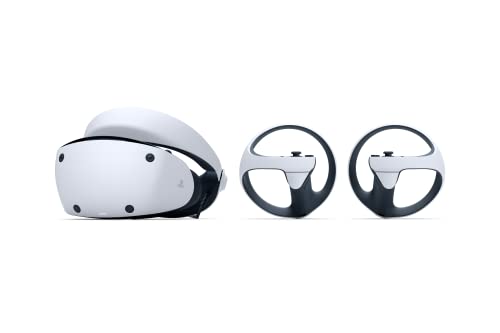
PlayStation VR2 Headset
OLED panels with eye tracked foveated rendering and headset haptics, and the only realistic VR route for a PS5 driver. Gran Turismo 7 support is the reason most people buy it.
Best for: PS5 drivers, especially Gran Turismo 7 players.
Check price
Meta Quest 3 512 GB VR Headset
Pancake lenses give a much larger sweet spot than the 3S, which matters when your head is fixed in a seat and you are reading apex markers at the edge of the lens rather than the centre.
Best for: Drivers who want lens clarity without moving to PC-only hardware.
Check price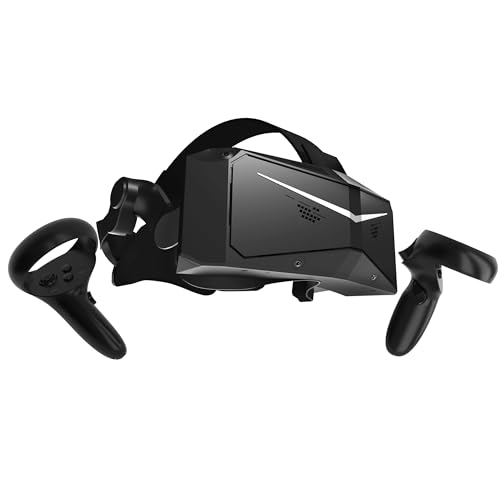
Pimax Crystal Light VR Headset, 2880x2880 per Eye
A PC-only headset built around pixel density and local dimming, which is what makes distant braking boards legible instead of a smear. It demands a strong graphics card and a tethered cable run.
Best for: PC sim racers with a high end GPU who read distance cues off the screen.
Check price
Pimax Crystal Super VR Headset, 3840x3840 per Eye
Very high per-eye resolution with a wide horizontal field of view and eye tracking. This is the top of consumer VR and it needs a top of the range graphics card to hold frame rate.
Best for: League and endurance racers whose whole rig is built around VR.
Check price
HTC VIVE Focus Vision Mixed Reality and PC VR Headset
Runs standalone or tethered to a PC with DisplayPort, and includes eye tracking. Worth considering only if you also want the headset for something other than driving.
Best for: Drivers who need one headset for sim racing and for work.
Check pricePrices change often, confirm on Amazon. As an Amazon Associate we earn from qualifying purchases.
Every VR headset compared on resolution and tether
Per-eye resolution figures are the manufacturers' published panel resolutions. Megapixel figures are calculated from them, and the both-eyes column is what your graphics card is asked to draw every frame.
| Headset | Per eye | MP per eye | MP both eyes | Refresh | Tether | Platform | Price |
|---|---|---|---|---|---|---|---|
| Meta Quest 3S | 1832 x 1920 | 3.52 | 7.03 | 90 or 120 Hz | Standalone, link cable or Wi-Fi | PC, standalone | $349.99 |
| PlayStation VR2 | 2000 x 2040 | 4.08 | 8.16 | 90 or 120 Hz | Single cable to the console | PS5 | $379.99 |
| Meta Quest 3 | 2064 x 2208 | 4.56 | 9.11 | 90 or 120 Hz | Standalone, link cable or Wi-Fi | PC, standalone | $599.00 |
| HTC VIVE Focus Vision | 2448 x 2448 | 5.99 | 11.99 | 90 Hz | Standalone or DisplayPort | PC, standalone | $1,262.79 |
| Pimax Crystal Light | 2880 x 2880 | 8.29 | 16.59 | Up to 120 Hz | Tethered to a PC | PC only | $1,053.00 |
| Pimax Crystal Super | 3840 x 3840 | 14.75 | 29.49 | Up to 90 Hz | Tethered to a PC | PC only | $1,799.00 |
The tether column is the one people ignore and then regret. A standalone headset such as the Quest 3S at $349.99 can run without a PC at all, and it connects to one over a cable or over Wi-Fi, which means a compression step sits between your graphics card and your eyes. A tethered headset such as the Pimax Crystal Super at $1,799.00 takes a DisplayPort feed with no compression, which is cleaner and also means a cable run to your rig that has to be routed so it does not catch on the wheel.
Which headset suits which platform?
On PlayStation the answer is short: the PlayStation VR2 at $379.99. It uses OLED panels with eye tracked foveated rendering, which renders at full detail only where you are looking, and it adds haptics in the headset itself. Gran Turismo 7 is the reason most people buy it, and the single cable to the console removes the entire PC setup problem. No Quest headset will work with a PS5.
On PC the ladder runs from the Quest 3S at $349.99 to the Quest 3 at $599.00, where the upgrade is lenses rather than raw pixels. Pancake lenses give a much larger sweet spot than the Fresnel style optics below them, and in a rig where your head is fixed in a seat and you are reading apex markers away from the centre of the lens, sweet spot size matters more than the resolution difference does.
Above that sit the specialist options. The Pimax Crystal Light at 2880 x 2880 per eye at $1,053.00 is built around pixel density and local dimming, which is what makes distant braking boards legible rather than a smear. The Pimax Crystal Super at 3840 x 3840 per eye at $1,799.00 adds a wide horizontal field of view and eye tracking, and needs a top of the range card to hold frame rate. The HTC VIVE Focus Vision at $1,262.79 runs standalone or tethered over DisplayPort and includes eye tracking, and it is worth considering mainly if the headset also has a job outside driving.
Is motion sickness a real problem in sim racing?
Sim racing is one of the gentlest cases in VR, and it is worth saying so plainly because the fear puts people off a purchase that would suit them. You are seated, your body is braced against a seat and pedals, your hands are on a wheel that moves the way the world moves, and the horizon behaves the way your inner ear expects. Compare that to a game where you walk with a thumbstick while your body sits still, which is the classic recipe for discomfort.
Three things cause most of the trouble that does occur. Dropped frames are the largest: any dip below the panel refresh registers as a wrongness your body reacts to before your mind names it. Inter pupillary distance set incorrectly is the second, and it takes 60 seconds to fix. Session length is the third: start at 20 minutes and build up over a week or two rather than attempting a one hour race on day one.
Two settings help a great deal. Turn off any in-car camera movement or head physics effect, since an artificial head bob in VR is your view moving without your neck moving. And keep the virtual seating position matched to your real one, which is easier if your physical geometry is fixed by a proper frame, as described in sim racing seating position.
What does comfort mean in a headset you wear seated?
Weight distribution rather than raw weight. A headset that balances front to back with a rigid strap and a rear counterweight sits comfortably for an hour, while a lighter headset with a soft strap presses on your cheekbones within 20 minutes. Most owners of the Quest family replace the default strap, and that is a normal $40 to $70 accessory rather than a defect.
Heat and fogging are the second reality. Your face is enclosed, you are concentrating, and a racing stint is physical. A small fan aimed at the rig fixes almost all of it, and it doubles as the airflow that makes long sessions bearable in any case. The third is the cable, on tethered headsets: route it over your shoulder and anchor it behind the seat so it cannot wrap around the wheel, which is a genuine safety point on a direct drive base.
Because you cannot see your controls, a VR rig depends on fixed geometry more than a screen rig does. A Next Level Racing GTRacer 2.0 at $499.99 or any frame that sets up identically every time makes a blind reach for a shifter land, and a PXN CB1 button box at $89.99 with physical toggles is far easier to use blind than a keyboard. The frame options are ranked in the best sim racing cockpit roundup.
Where to go next
If you are still deciding between a headset and a screen array, read VR versus triple monitors and triple monitors versus ultrawide, then price both against your current graphics card rather than against each other. If a screen array wins, the panels are ranked in the best sim racing monitor roundup. If VR wins, budget the graphics card in the same purchase, because a headset your card cannot feed is the one situation where more money buys a worse experience.
Safety note: in VR you cannot see the room. Clear the area around the rig before you put the headset on, keep cables routed behind the seat and away from the wheel, and never let anyone approach a running direct drive base while you are unable to see them.
Frequently asked questions
What is the best VR headset for sim racing?
The Meta Quest 3S at $349.99 for most people, because it runs PC sim titles well over a link cable or Wi-Fi and needs no base stations around the rig. If lens clarity at the edges matters to you, the Meta Quest 3 at $599.00 uses pancake lenses with a much larger sweet spot, which counts when your head is fixed in a seat and you are reading apex markers away from the centre of the lens.
How much graphics card does VR sim racing need?
More than triples, usually. A Meta Quest 3 renders 9.11 megapixels across both eyes against 11.06 for triple 1440p, which looks favourable until you note that VR must hold 90 frames per second as a floor rather than a target, and most drivers add supersampling on top. A Pimax Crystal Light at 16.59 megapixels needs a high end card before it is playable at all.
Will VR make me motion sick?
Less often than in most VR content, because sim racing is one of the gentler cases: you are seated, your body is braced, and the horizon behaves the way your inner ear expects. The problems come from dropped frames, a badly set inter pupillary distance and long first sessions. Start with 20 minute stints, hold a locked frame rate, and set the lens spacing properly before deciding VR does not agree with you.
Can I use a Quest 3 with a PS5?
No. The Quest family works standalone or with a PC, and a PS5 will not drive it. The only realistic VR route on PlayStation is the PlayStation VR2 at $379.99, which connects to the console with a single cable and is the reason many Gran Turismo 7 players buy into VR at all. Sony sells an adapter that lets the VR2 run PC VR titles, but the console side is a closed route.
Is VR better than triple monitors for sim racing?
For depth perception and car placement, yes, clearly. Judging a braking point and the width of a gap is easier when the world has genuine scale. For everything else it is a trade: you cannot see your rim, your button box or a drink, sessions are shorter, and streaming or coaching is harder. Many drivers own both and pick by discipline rather than declaring a winner.
Does a VR rig still need a cockpit?
More than a screen rig does. In VR you cannot see your hands, so every control has to be exactly where your muscle memory expects it, every session. A folding frame that sets up slightly differently each time removes that certainty. A fixed cockpit such as the Next Level Racing GTRacer 2.0 at $499.99 fixes the geometry so a blind reach for the shifter lands.
How we choose: we compare published manufacturer specifications, documented torque and travel figures, and verified owner reviews. We do not test gear in person. Everything here is researched guidance, not professional installation advice. Direct drive wheelbases produce enough torque to injure a wrist, and rig hardware carries real weight, so follow the manufacturer's mounting and torque limits.