Best Sim Racing Monitor: Triples and Ultrawide
The best sim racing monitor for most builds is a 27 inch 1440p high refresh panel such as the Acer Nitro XV271U at $169.99, bought once now and twice more later to form triples, because field of view is set by how much of your vision the screen fills rather than by diagonal size alone.
The best sim racing monitor for most rigs is the Acer Nitro XV271U 27 inch QHD 180 Hz panel at $169.99, not because a single 27 inch screen is impressive on its own, but because three identical ones are the standard route to a proper triple array and this is the cheapest way to get there from a known brand. The rule that governs every choice on this page: field of view is set by how much of your vision the screen fills, which is width divided by viewing distance, not by the diagonal on the box. A small screen close to you beats a large screen far away, every time.
The geometry that decides everything
Correct horizontal field of view in degrees is two times the arctangent of half your screen width divided by your viewing distance. Screen width is not the diagonal: for a 16:9 panel it is the diagonal times 0.8716, for 21:9 it is about 0.9457, and for 32:9 it is about 0.9808. That means a 27 inch 16:9 panel is roughly 23.5 inches wide, and at 24 inches from your eyes it fills about 52 degrees. A 49 inch 32:9 panel is roughly 48 inches wide, and at the same distance it fills about 90 degrees. The 49 inch screen is 81 percent larger by diagonal and delivers 73 percent more angle, which is a real gain but nothing like the headline number suggests.
Run your own numbers rather than copying someone else's setting. The triple monitor FOV calculator handles the angled side panels, and the monitor size and distance calculator tells you what a given panel gives you at a given seating distance before you buy it. Correct field of view always feels too narrow on the first few laps, because a wide setting shows more scenery and reads as more exciting. It also compresses apparent distance, which is why drivers running wide settings brake at inconsistent points and blame the pedals.
Best sim racing monitors by tier
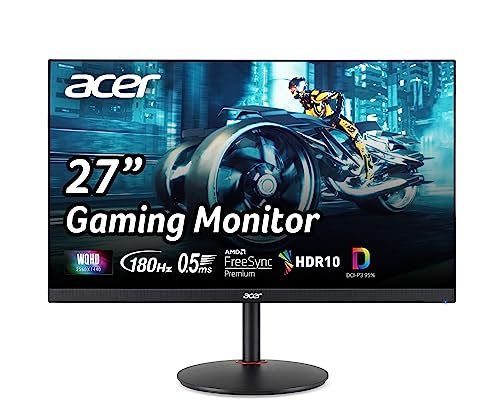
Acer Nitro XV271U 27 inch QHD 180 Hz Gaming Monitor
Buying three identical 27 inch 1440p panels is the standard route to triples, and this is the cheapest way to do it from a known brand with thin bezels and 180 Hz.
Best for: Building a triple screen array one panel at a time.
Check price
ASUS TUF Gaming VG27AQ3A 27 inch 1440p 180 Hz Monitor
Fast IPS at 1440p and 180 Hz, which is the sweet spot where a mid-range GPU can still hold a locked frame rate in a busy first lap.
Best for: A single-screen rig that may become the centre panel of triples later.
Check price
LG UltraGear 34 inch Curved QHD 3440x1440 160 Hz Monitor
A 21:9 ultrawide gives most of the peripheral awareness of triples with one cable, one stand and no bezel correction to configure.
Best for: Rigs with a wheel deck too narrow to carry three panels.
Check price
LG UltraGear 34GS95QE 34 inch OLED 240 Hz Curved Monitor
OLED response time removes the smear that shows up on a fast pan through a corner, and 800R curvature at 34 inches keeps the edges at a consistent distance from your eyes.
Best for: Drivers who want ultrawide but refuse to accept the motion clarity penalty.
Check price
Samsung Odyssey G9 49 inch DQHD 240 Hz Curved Monitor
A 32:9 super ultrawide covers roughly the horizontal span of triple 27 inch panels from one input, with a 1000R curve that suits a fixed seating position.
Best for: A single-panel alternative to triples, on a GPU that can drive 5120x1440.
Check price
LG UltraGear 27GR83Q-B 27 inch QHD 240 Hz IPS Monitor
A 240 Hz 1440p IPS panel with a tilt, height and pivot stand, which is what lets three of them be angled and levelled to match one seating distance. Buying three identical panels is the only sane way to build triples.
Best for: Triple screen arrays where all three panels must match exactly.
Check pricePrices change often, confirm on Amazon. As an Amazon Associate we earn from qualifying purchases.
Who should skip the Expert tier: the Samsung Odyssey G9 49 inch DQHD is a 5120x1440 panel, which is roughly 7.4 million pixels, about twice a single 1440p screen. On a graphics card that already struggles to hold a locked frame rate on one 1440p monitor, a $899.99 super ultrawide buys you a wider view of a stuttering picture. Frame time consistency matters more than width in a braking zone. Check what your system does on a full grid first with the PC spec calculator, and if the answer is marginal, buy the LG UltraGear 34 inch at $248.00 and upgrade the card first.
Triples, ultrawide and what each actually gives you
| Setup | Resolution | Megapixels | Screen width | FOV at 24 in | Price |
|---|---|---|---|---|---|
| Single 27 in 16:9 | 2560x1440 | 3.7 | 23.5 in | 52 deg | $169.99 |
| Triple 27 in 16:9 | 3 x 2560x1440 | 11.1 | 70.6 in total | 150 deg | $509.97 |
| 34 in 21:9 ultrawide | 3440x1440 | 5.0 | 32.2 in | 68 deg | $248.00 |
| 34 in 21:9 OLED | 3440x1440 | 5.0 | 32.2 in | 68 deg | $699.99 |
| 49 in 32:9 super ultrawide | 5120x1440 | 7.4 | 48.1 in | 90 deg | $899.99 |
Read the width column, not the price column. Triples at roughly $510 for three Acer panels deliver more than 150 degrees, which no single panel at any price matches, because a single flat screen cannot wrap past the edges of your peripheral vision. That is the entire argument for triples and it is a strong one. The argument against is everything else: three times the pixel load, a wheel deck wide enough to carry the side panels, mounts, bezel correction and three cables. The full trade is laid out in the triple monitors versus ultrawide comparison.
The triples route
Buy identical panels. Mismatched screens differ in colour temperature, brightness and response, and the seams draw your eye to every difference. Three of the Acer Nitro XV271U at $169.99 each is the standard build because 27 inches at 1440p is the largest panel most people can sit 24 inches from without turning their head, and 180 Hz leaves headroom.
Angle the side panels inward so that each screen sits roughly perpendicular to your line of sight at its centre. Flat side panels look wrong because the geometry the sim renders assumes you angled them. Then set bezel correction so the track stays continuous across the joins. The mechanical and software steps are covered in the triple monitor setup guide. Budget for a monitor mount rated for the combined weight, because three panels cantilevered off a wheel deck put real leverage into the frame, and a stand that wobbles under braking undoes the stability the frame was bought for.
If the budget stretches, the panel to build triples from is the LG UltraGear 27GR83Q-B at $265.27, which ships with a tilt, height and pivot stand. That matters more on triples than on a single screen, because all three panels have to be levelled and angled to one seating position, and a fixed height stand forces you to shim. Three of them is $795.81 against $509.97 for three Acer panels, so it is a $286 premium for 240 Hz and a far more adjustable stand. Take the cheaper panels if the graphics card is already the constraint, which at 11.06 megapixels per frame it usually is.
The ultrawide route
An ultrawide is one cable, one stand, no bezel correction and no seams. The LG UltraGear 34 inch curved at $248.00 gets you to roughly 68 degrees, which is a genuine improvement over a single 16:9 panel and enough peripheral information to place a car beside you in a corner. It is also the right answer for any rig whose wheel deck is too narrow to carry three panels, which includes most folding cockpits and every wheel stand.
Curvature matters more here than on a flat panel. An 800R curve on a 34 inch screen keeps the edges roughly the same distance from your eyes as the centre, which is exactly what the field of view maths assumes. A gently curved or flat super ultrawide stretches the image toward the edges. Going up to 32:9 doubles the pixel load against a single 1440p panel and roughly matches the horizontal span of triples from one input, which is a fair trade if your graphics card is comfortable at 5120x1440 and not otherwise.
What refresh rate do you actually need?
Less than the marketing suggests, and stability matters more than the number. A locked 90 frames per second feels better to drive behind than a figure swinging between 70 and 140, because your braking and steering inputs are timed against what you see, and a variable frame time makes the car feel inconsistent when nothing about the car has changed. If you have to choose between a higher average and a flatter frame time, take the flatter frame time.
The practical bands are these. Sixty hertz is genuinely playable and genuinely limiting: a fast pan through a corner smears and small corrections feel late. Between 120 and 144 hertz is where almost everyone stops noticing the display at all, which is why the Acer Nitro XV271U at $169.99 at 180 Hz and the ASUS TUF VG27AQ3A at $209.00 at 180 Hz are the two most sensible panels on this page. Above 144 hertz the returns get small quickly, and on triples the graphics card is the binding constraint long before the panel is.
That last point is worth arithmetic. Triple 1440p renders 11.06 megapixels per frame. At 240 frames per second that is 2,654 megapixels per second, which is beyond what most consumer graphics cards deliver in a demanding sim at high detail. Buying 240 Hz panels for triples usually means buying a frame rate you will not reach. Size the machine and the panels together with the PC spec calculator rather than in sequence.
Does panel technology matter for sim racing?
Three properties matter and the rest is noise. Motion clarity decides whether a kerb stays legible as you pan across it. Contrast decides whether you can see into a shadowed braking zone at Le Mans at night. Colour and brightness matching only matters on triples, where three panels have to look like one image.
| Panel type | Motion clarity | Contrast | Best use in a rig | The catch |
|---|---|---|---|---|
| Fast IPS | Good | Moderate | Triples, where three must match | Blacks look grey in night races |
| VA | Weaker on dark transitions | Strong | Large curved single panels | Smearing on dark to light motion |
| OLED | Best available | Best available | A single premium ultrawide | Cost, and static overlay elements |
| Television panel | Varies, often poor | Often strong | A cheap large screen at distance | Input lag and low pixel density |
For triples, fast IPS is the correct answer nearly every time, because matching three panels matters more than any single panel property. For one screen, the LG UltraGear 34GS95QE OLED at $699.99 is the honest top of the category and the price reflects it. A television is a reasonable stopgap and a poor destination: pixel density falls, input lag rises, and the extra distance it demands costs rig length, which the rig space calculator will price against your room.
What else do you have to buy alongside the panels?
- A mount that can angle the side panels, on triples. A fixed desk stand cannot, and flat side panels are the single most common reason a triple array looks worse than one screen. A MOUNTUP triple monitor stand at $66.48 is the cheap route. Check its weight rating against your real panel mass first.
- Three display outputs on the graphics card itself. Splitters and adapters introduce their own bandwidth limits, and the output count is the constraint people discover last, after the panels have arrived.
- Cables that carry the mode you bought. A high refresh rate at high resolution needs the right DisplayPort or HDMI revision, and a cable from a drawer frequently does not.
- Graphics headroom, budgeted at the same time. Two extra 27 inch panels cost about $340 and often another $400 to $800 in graphics card to drive them. Price the whole change, not the panels.
Once the hardware is chosen, the setup itself decides how it feels. Run your panel size and seating distance through the monitor size and distance calculator, take the panel angle from the triple monitor FOV calculator, and set bezel correction using how to set up triple monitors. Every size and distance combination is tabulated on the monitor size and FOV chart.
Frequently asked questions
Is one big TV as good as three monitors for sim racing?
Almost never, because a television is designed to be viewed from across a room and a sim screen is viewed from arm's length. A 55 inch TV at 60 inches away fills a narrower slice of your vision than a 27 inch panel at 24 inches away, and it usually adds input lag and drops to 60 Hz. If a large panel is the only option, pull it as close as the wheel allows and check the refresh rate the input actually accepts.
How many degrees of field of view should I run?
Run whatever your geometry produces, not a number you liked the look of. Correct horizontal field of view is twice the arctangent of half your screen width divided by viewing distance. Three 27 inch panels at 24 inches away land near 150 degrees total, a single 27 inch panel near 52 degrees. Correct field of view almost always feels too narrow at first, which is exactly why so many drivers set it wide and then misjudge braking points all season.
Do I need bezel correction with triple monitors?
Yes, if you want the track to stay geometrically continuous across the seams. Bezel correction tells the sim how much image is hidden behind the plastic frame between panels, so a kerb crossing a seam still lines up. Without it the world visibly jumps at every join and distance judgement suffers. It is a few minutes of setup in your GPU software and the sim itself, and it is the difference between three screens and one wide picture.
Will a mid range GPU drive triple 1440p?
Triple 1440p is roughly 11.1 million pixels against 3.7 million for a single 1440p panel, so budget for about three times the graphics load. Sim racing is also unusually CPU heavy at the start of a race when a full grid is on screen, so a fast GPU with a weak processor still drops frames on lap one. If your card is already working hard on one panel, an ultrawide is the more honest upgrade than triples.
Is an OLED ultrawide worth double the price of an LCD ultrawide?
It buys motion clarity, not field of view. The LG UltraGear 34GS95QE at $699.99 has near instant pixel response, so the trackside detail stays sharp during a fast pan through a corner instead of smearing. The LG UltraGear 34 inch at $248.00 shows you exactly the same amount of world. If your complaint is that you cannot see enough, spend on width. If your complaint is that fast corners look soft, spend on OLED.
Can I start with one monitor and add two later?
Yes, and it is the cheapest sensible path. Buy a panel that is available as an identical unit, because mismatched panels produce visible colour and brightness steps across the array. Three matching 27 inch 1440p screens is the standard triple build for a reason. Confirm your graphics card has three usable outputs of the right type before committing, and confirm the wheel deck is wide enough to carry the side panels.
How we choose: we compare published manufacturer specifications, documented torque and travel figures, and verified owner reviews. We do not test gear in person. Everything here is researched guidance, not professional installation advice. Direct drive wheelbases produce enough torque to injure a wrist, and rig hardware carries real weight, so follow the manufacturer's mounting and torque limits.