Best Sim Racing Wheel Under $300: What Each Price Buys
The best sim racing wheel under $300 is the Logitech G920 at $199.99 on Xbox and PC, or the identical Logitech G29 at $199.99 on PlayStation. Both give gear driven force feedback, 900 degrees of rotation and three pedals, and both have the widest game, mount and cockpit support of anything in this bracket.
The best sim racing wheel under $300 is the Logitech G920 at $199.99 on Xbox and PC, or the mechanically identical Logitech G29 at $199.99 on PlayStation. Neither is the smoothest wheel in this bracket and neither is the newest, but both include force feedback, 900 degrees of rotation and three pedals in one box, and both carry more game, mount and cockpit support than anything else here. This is the biggest single bracket in the hobby, and it is also the one where the price ladder is steepest: the gap between $120, $200 and $300 is not a gap in quality, it is a gap in what the product does.
What does $120 actually buy?
A better controller. The Thrustmaster T80 at $119.95 has no force feedback motor at all, only a vibration motor, and it turns 270 degrees rather than 900. It has two pedals. Everything about it is aimed at making an arcade racer more fun to play with a wheel in your hands, and at that job it succeeds.
What it cannot do is teach you anything. The entire value of force feedback in a simulation is that the car communicates its grip state through the wheel: the front tyres beginning to wash wide, the rear stepping out, the surface changing under one side. Without a motor holding torque against your hands, none of that arrives, and you are steering by what you can see. Drivers who start on a vibration wheel usually conclude that sim racing is hard and unrewarding, which is a fair conclusion from that hardware and the wrong conclusion about the hobby.
The honest advice is to wait. Another $80 moves you into the bracket where the wheel pushes back, and that is the entire difference between a toy and a tool. If the budget genuinely stops at $120 and will not move, buy the T80 and enjoy it, but do not expect it to translate into lap time.
What does $200 buy, and why is it the real entry point?
Three genuinely different wheels sit at almost exactly $200, and choosing between them is mostly a platform question.
The Logitech G920 at $199.99 and the Logitech G29 at $199.99 are the same wheel with different console authentication and a rev light strip on the PlayStation version. Dual motors drive a helical gear train, which produces firm, unmistakably mechanical feedback with audible gear noise and a small dead spot at centre that never fully disappears. Three pedals are included. What you are buying beyond the specification is the ecosystem: every game lists them, every wheel stand and cockpit has a mounting pattern for them, and every shifter compatibility note starts with them.
The Thrustmaster T128 P at $199.99 takes a different approach at the same price. Its HYBRID DRIVE mixes a belt with gears, which removes most of the notchiness a pure gear train has, and its two pedal set uses a magnetic brake sensor that resolves far more finely than a plain potentiometer. You lose the clutch pedal and you lose some of the Logitech ecosystem breadth. You gain feedback that reads smoother through a long corner, which is where a gear wheel feels most obviously mechanical.
At $200 you are buying a complete working setup: a wheel, a motor and pedals, from one manufacturer, at one price. That is the correct shape for a first purchase, and it is why the beginner sim racing setup is built around this bracket rather than around a base and separate parts.
What does $300 buy that $200 does not?
Two different things, and they point in opposite directions.
The first is refinement of the same idea. The Logitech G923 at $299.99 is the G29 mechanism plus TRUEFORCE, which drives the motor from the game audio engine as well as from the physics model. In practice that means tyre scrub, kerb texture and engine load arrive as texture rather than as a rumble motor buzzing. It is still gear driven, it still has the centre dead spot, and it is the most polished version of a wheel design that is now a decade old. The Thrustmaster T248 X at $239.99 at $239.99 sits between the two, adding a dash screen so force settings change without leaving the car and magnetic paddles that do not wear out the way microswitches do.
The second is a change of category. The Turtle Beach VelocityOne Race KD3 at $279.99 and the MOZA R3 bundle at 3.9 Nm at $299.99 are genuine direct drive: the rim mounts to the motor shaft with no gears and no belt between it and your hands. They are weaker in absolute force than a G920 feels, and they carry far more information. Small forces that a gear train blurs into its own noise arrive intact. The mechanism, and why weaker can read better, is explained in direct drive versus belt versus gear.
The HORI Force Feedback Racing Wheel DLX at $265.18 is the outlier at $265.18. Its force feedback is modest against a G920 or a T248, and its argument is the rim and the button count: a metal rim with a layout closer to a real GT car, officially licensed for Xbox. That is a real preference, just not a feedback one.
Best sim racing wheels under $300 by tier

Thrustmaster T80 Racing Wheel and Pedals
No force feedback at all, only a 270 degree rotation range and a vibration motor. It is a better controller, not a simulator, and the only reason to buy it is a budget that genuinely stops at $120.
Best for: Casual arcade racers and a first taste of driving with a wheel.
Check price
Logitech G920 Racing Wheel and Pedals
Dual motor gear driven force feedback, 900 degrees of rotation and three pedals. The most widely supported wheel in the hobby, so every game, mount and cockpit names it explicitly.
Best for: Xbox and PC drivers who want the widest compatibility for the least money.
Check price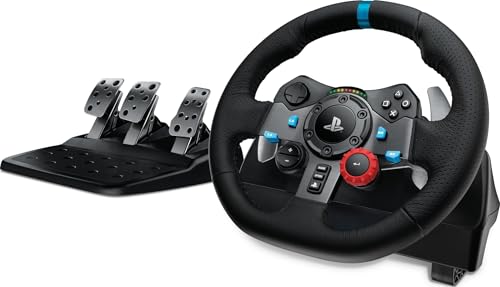
Logitech G29 Racing Wheel and Pedals
The same mechanism as the G920 with PlayStation buttons and a rev light strip. Buy this one for a PS4 or PS5, because the G920 will not authenticate on Sony hardware.
Best for: PlayStation drivers buying their first wheel.
Check price
Thrustmaster T128 P Force Feedback Racing Wheel and Pedal Set
Thrustmaster HYBRID DRIVE mixes a belt with gears, so it avoids the notchiness of a pure gear wheel, and the set includes a magnetic brake pedal that resolves far more finely than a plain potentiometer.
Best for: PS5 drivers who want smoother feedback than a gear wheel at the same price.
Check price
Thrustmaster T248 X Force Feedback Racing Wheel and Pedal Set
Hybrid belt and gear drive plus a dash screen that lets you change force settings without leaving the car, and magnetic paddle shifters that do not wear out the way microswitches do.
Best for: Drivers who want a real step up in feedback quality under $250.
Check price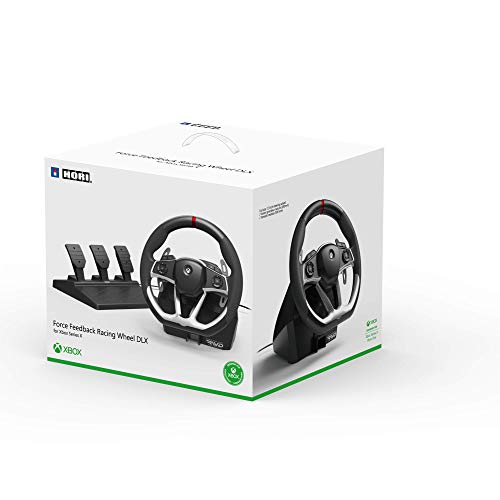
HORI Force Feedback Racing Wheel DLX for Xbox Series X and S
An officially licensed Xbox wheel with a metal rim and a large button count, useful if you want a layout closer to a real GT car than the Logitech pod. Force feedback strength is modest.
Best for: Xbox drivers who value button layout and rim feel over raw force.
Check price
Logitech G923 Racing Wheel and Pedals for PlayStation and PC
The G29 mechanism plus TRUEFORCE, which drives the motor from the game audio engine as well as the physics model, so tyre scrub and engine load arrive as texture rather than as a rumble motor.
Best for: Drivers at the top of this budget who want the most refined gear driven wheel.
Check price
Turtle Beach VelocityOne Race KD3 Direct Drive Wheel and Pedals
A direct drive base and pedals inside the $300 ceiling with Xbox support, which almost nothing else manages. Direct drive removes the gear train entirely, so kerb detail is not smeared on the way to your hands.
Best for: Xbox drivers who want direct drive without spending twice this much.
Check price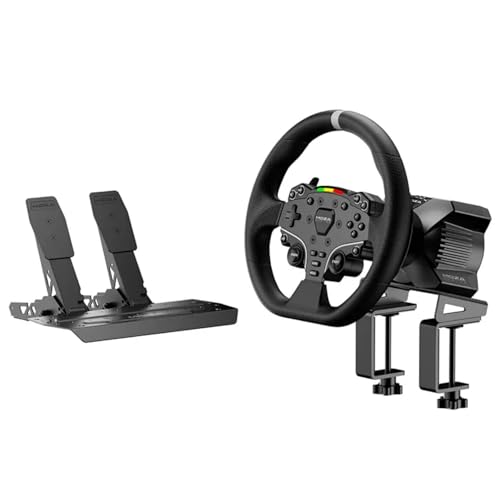
MOZA R3 Racing Wheel and Pedals Bundle, 3.9 Nm Direct Drive
A complete direct drive wheel, rim and pedal bundle under $300 that clamps to a desk. Lower peak torque than a gear wheel feels like, but the detail arriving through it is a different category.
Best for: PC drivers who care about feedback quality more than raw strength.
Check pricePrices change often, confirm on Amazon. As an Amazon Associate we earn from qualifying purchases.
Every wheel under $300 compared
Rotation is the manufacturer's published figure where one exists. Logitech does not publish a newton metre rating for its gear driven wheels, and several manufacturers publish rotation as a software adjustable range rather than a fixed number, so those cells say so rather than inventing a figure. Pedal count is what ships in the box.
| Wheel | Drive type | Rotation | Pedals | Platform | Price |
|---|---|---|---|---|---|
| Thrustmaster T80 | No force feedback, vibration only | 270 deg | 2 | PS5, PS4, PC | $119.95 |
| Logitech G920 | Dual motor gear driven | 900 deg | 3 | Xbox, PC | $199.99 |
| Logitech G29 | Dual motor gear driven | 900 deg | 3 | PS5, PS4, PC | $199.99 |
| Thrustmaster T128 P | HYBRID DRIVE, belt and gear | 900 deg | 2 | PS5, PS4, PC | $199.99 |
| Thrustmaster T248 X | HYBRID DRIVE, belt and gear | 900 deg | 3 | Xbox, PC | $239.99 |
| HORI Force Feedback Racing Wheel DLX | Gear driven | Not published | 3 | Xbox, PC | $265.18 |
| MOZA R3 bundle | Direct drive, 3.9 Nm | Software adjustable | 2 | Xbox, PC | $279.99 |
| Logitech G923 | Gear driven with TRUEFORCE | 900 deg | 3 | PS5, PS4, PC | $299.99 |
| Turtle Beach VelocityOne Race KD3 | Direct drive | Not published | 3 | Xbox, PC | $299.99 |
Read that table by column rather than by row. The drive type column separates three genuinely different products, the pedal column tells you whether you can drive an H-pattern car properly, and the platform column removes about half the list before you have compared anything. Price is the least useful column here, because seven of the nine sit inside $100 of each other.
Does your platform shorten the list?
Severely, and this is the first filter to apply. Consoles authenticate accessories in hardware, which means compatibility is not a driver problem you can work around. The G920 will not authenticate on a PlayStation, and the G29 will not authenticate on an Xbox. No adapter fixes either reliably.
On PlayStation the list is the G29, the Thrustmaster T128 P at $199.99, the Logitech G923 at $299.99 and the T80. On Xbox it is the G920, the T248 X at $239.99, the HORI DLX at $265.18, the Turtle Beach KD3 at $279.99 and the MOZA R3. On PC the whole table is available, which is the single strongest argument for racing on a PC even if you own a console. The PlayStation specific ladder, including what happens above $300, is on the best sim racing wheel for PS5 page, and the full model by model matrix is in the wheel compatibility chart.
Does rotation range actually matter?
It matters for what you drive, not universally. Nine hundred degrees means two and a half turns lock to lock, which matches a road car, a rally car and most vintage racing machinery. Modern GT and formula cars often use under 400 degrees, and the game maps the wheel to the car's real lock regardless, so a 900 degree wheel driving a formula car simply uses part of its range.
Where it becomes decisive is at the bottom of the table. The T80's 270 degrees is a hardware limit, not a setting, and there is no way to create rotation the mechanism does not have. Driving a rally stage on 270 degrees means the wheel runs out before the car has finished turning. If you drive anything with meaningful steering lock, treat 900 degrees as a requirement rather than a feature.
What should the rest of the budget go on?
The frame, almost always. A wheel clamped to a desk with pedals sliding on carpet wastes most of what separates a $299.99 wheel from a $199.99 one, because the geometry changes every time you sit down and the pedals move under braking. A Next Level Racing Wheel Stand Lite 2.0 at $179.00 fixes the pedals relative to the wheel and folds away, and a Next Level Racing GTLite at $253.26 does the same job while also fixing the seat. Either is a bigger change than moving one rung up the wheel ladder.
After the frame, braking. Every wheel in this bracket ships with a travel based brake pedal, and a pressure based one is the upgrade most directly tied to consistency. A Logitech G RS load cell set at $159.99 or the Thrustmaster Raceline Pedals III at $169.99 is where that starts, and the reasoning is set out in load cell versus potentiometer pedals. A shifter such as the Logitech G Driving Force Shifter at $44.99 is worth adding only if you drive cars with an H-pattern gearbox, and note that it works only with the G29, G920 and G923.
Where to go next
If this bracket feels tight, the complete build that surrounds a $199.99 wheel is costed line by line in the beginner sim racing setup, and the parts worth prioritising are ranked in best budget sim racing setup. If you are already tempted by direct drive, the direct drive wheelbase roundup explains what each torque figure demands from your mounting before you commit. And if you are unsure which brand ecosystem to enter, Logitech versus Thrustmaster compares the two ladders you are choosing between.
Safety note: even a gear driven wheel can snap back hard during a calibration sweep or a heavy kerb strike. Keep your thumbs outside the spokes, mount the wheel so the clamp bears on solid material rather than a hollow desk top, and check the clamp before every session, because a wheel that pulls free at speed takes the desk edge with it.
Frequently asked questions
What is the best sim racing wheel under $300?
The Logitech G920 at $199.99 for Xbox and PC, or the mechanically identical Logitech G29 at $199.99 for PlayStation. Neither has the smoothest feedback in this bracket, but both include three pedals, 900 degrees of rotation and the widest software, mount and cockpit support in the hobby. If smoother feedback matters more than ecosystem breadth, the Thrustmaster T248 X at $239.99 reads better through a corner.
Is a $120 wheel worth buying at all?
Only if your budget genuinely stops at $120. The Thrustmaster T80 at $119.95 has no force feedback motor, 270 degrees of rotation and two pedals, so it is a better controller rather than a simulator. Without feedback the car cannot tell you when the front tyres let go, which is the single most useful thing a wheel does. Saving another $80 for a G920 or G29 changes what you can learn.
Can I get direct drive under $300?
Yes, in two forms. The MOZA R3 bundle at $279.99 is a complete 3.9 Nm direct drive wheel, rim and pedal set for PC and Xbox that still clamps to a desk. The Turtle Beach VelocityOne Race KD3 at $299.99 is an Xbox licensed direct drive wheel and pedal set. Both trade peak strength for signal quality, so they feel lighter than a G920 while carrying far more detail.
Do I need three pedals or will two do?
Two is enough for anything with paddles or an automatic gearbox, which covers most modern GT and formula racing. A clutch matters if you drive vintage cars, rally stages or anything with an H-pattern gearbox, and it matters for standing starts in league racing. The Thrustmaster T128 P at $199.99 and the MOZA R3 bundle at $279.99 both ship with two pedals, while the Logitech sets include three.
Does 900 degrees of rotation matter?
It matters for road cars, rally and drift, where the steering lock genuinely goes past 360 degrees and shuffling your hands is part of driving. It matters far less in formula and modern GT racing, where lock is often under 400 degrees. The Thrustmaster T80 at 270 degrees is the one to avoid on this basis: no software setting can create rotation the hardware does not physically have.
What should I spend the rest of my budget on?
The frame, not the wheel. A Next Level Racing Wheel Stand Lite 2.0 at $179.00 fixes the pedals relative to the wheel, which is the difference between a repeatable brake point and a new one every lap. A desk clamped wheel with pedals sliding on carpet wastes most of what a $299.99 wheel offers over a $199.99 one.
How we choose: we compare published manufacturer specifications, documented torque and travel figures, and verified owner reviews. We do not test gear in person. Everything here is researched guidance, not professional installation advice. Direct drive wheelbases produce enough torque to injure a wrist, and rig hardware carries real weight, so follow the manufacturer's mounting and torque limits.